Email: Sales@fusort.com
Language:
 ∷
∷

∷
∷
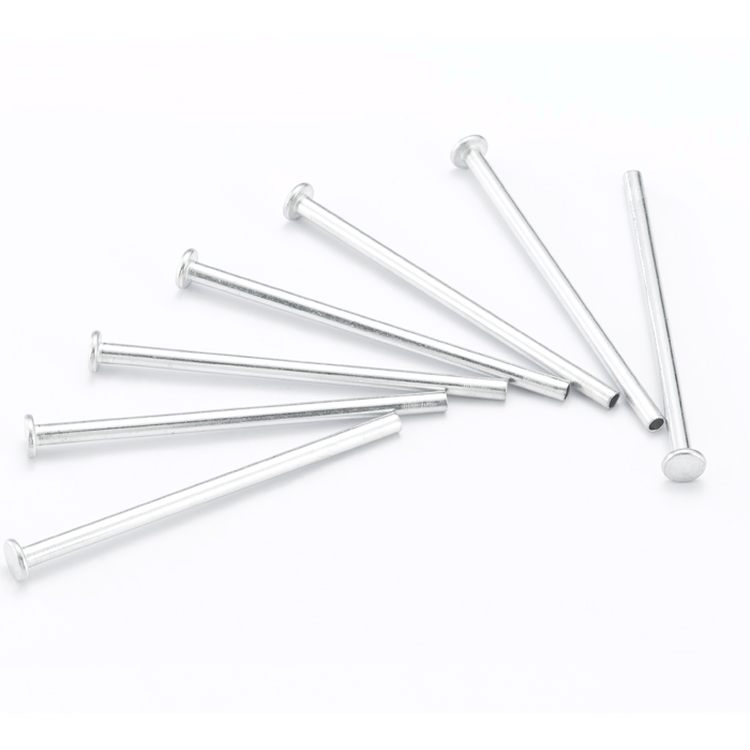
Full Hollow Long Rivet: Straightness Control & Surface Finish — Automotive Case Study
Fusort Machinery Engineering Team
Reviewed: September 30, 2026
Matrix
Part type: Full hollow, extra-long rivet
Material: Stainless steel
Batch scale: Mass production, not single-piece sampling
Industry: Automotive
Objective
The rivet needed to pass smoothly through the customer's custom-made assembly fixture, seating correctly at the center and both end positions. The fixture is a customer-proprietary design with no standard model number, so acceptance was defined by successful fit-through rather than a numeric tolerance. Consistency across the full batch was equally critical — every unit in every box needed to pass, not just individual samples — with no visible rust at delivery.
Selection
We ran into and resolved three distinct issues over the course of this project, each surfacing only after the previous one was addressed:
First, straightness control. The part's length made it prone to slight deformation during machining, causing the three reference points to drift out of alignment. We ran multiple rounds of sample testing, adjusting machining speed and process parameters (specific equipment/tooling: 【Please verify】) until straightness held within the customer's required range.
Second, packaging-induced deformation. Once machining was dialed in, standard packaging caused a new problem: stacking too many units per box compressed the bottom layer, bending parts that had already passed inspection. We redesigned the packaging — limiting units per box and switching to a layered wooden crate structure — to prevent deformation under sustained weight during transport.
Third, rust from incomplete cleaning. With straightness and packaging resolved, a third issue emerged in the cleaning stage: localized rust from incomplete cleaning. We controlled the batch size per wash cycle, calibrated detergent concentration, extended rinse duration, and adjusted bake time, adding a natural air-drying step after baking (specific cleaning/inspection standard: 【Please verify】) — which fully resolved the issue.
Status
In stable mass production under an ongoing supply relationship with the customer.
FAQ
Does this straightness control approach apply to shorter rivets?
The underlying logic applies, but shorter parts carry inherently lower deformation risk, so the required process adjustment is typically much smaller. Specific parameters still need re-validation based on part length rather than being applied directly.
If a different stainless steel grade is required (e.g., 316L for higher corrosion resistance), would this cleaning process still apply?
The batch-size and rinse-duration logic transfers across grades, but different stainless steel grades vary slightly in detergent tolerance — specific concentrations should be re-tested for the actual grade in use.
Is this packaging approach specific to extra-long parts?
The layered-crate-with-capped-quantity approach applies to any slender part prone to compression deformation. The exact unit count per box needs to be recalculated based on part weight, length, and material strength — it isn't a fixed number.
Further Reading:
Why Does a Stainless Steel Rivet Rust?
Stainless Steel 304 vs 316 for Fasteners
If your project involves similar long, precision-critical components, reach out to our engineering team
Contact: Jeffrey Chen
Phone: 18896588126
Tel: 0512-63256033
Email: Sales@fusort.com
Add: Fenhu Economic Development Zone, Wujiang District, Suzhou City, Jiangsu Province, China