Email: Sales@fusort.com
Language:
 ∷
∷

∷
∷
Stainless Steel 304 vs 316 for Fasteners: How to Actually Choose
Written by: Fusort Machinery Engineering Team Reviewed: September 24, 2026
(Scope note: This is written from the material selection questions we get asked most often. It's meant to help you narrow down the right direction — for specific projects, we'd still recommend confirming against your actual environment and, where needed, third-party salt spray testing.)
The question we hear almost every week: "316 must be better, so should we just use it everywhere?"
Most customers' first instinct is "316 costs more, so it must be better," and then they want to standardize on 316L across the board. That instinct isn't wrong exactly, but it isn't the right question either. Using 316L everywhere means paying for corrosion resistance you don't need in a lot of applications, and — the part people miss more often — assuming 304 is "good enough everywhere" can mean corrosion problems in the specific environments where it isn't.
The real difference isn't which grade is "better." It's which environment each one is actually built to handle.
What actually separates 304 from 316
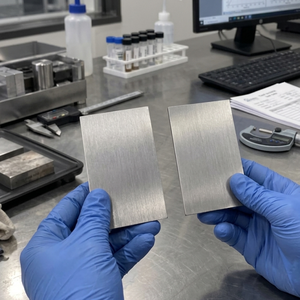
Chemically, 316 and 316L add molybdenum on top of the base 304 composition, and that one element is what changes how each grade behaves in a chloride environment. 304 holds up perfectly well in most indoor, dry, general industrial settings — its corrosion resistance isn't weak. But once it's exposed long-term to chlorides — coastal air, de-icing salt, pool environments, chlorinated cleaning agents — the passive layer on 304 is more prone to localized breakdown, showing up as pitting. 316/316L resists that same pitting mechanism noticeably better because of the molybdenum.
Put another way, the gap between 304 and 316 doesn't show up in a lab under ideal conditions — it shows up in the field, under chloride exposure, in which one starts failing first.
How to decide which one you actually need
Does the end-use environment involve chloride or salt spray exposure? If the part goes into coastal outdoor installations, marine equipment, pool equipment, or bridge/roadway hardware exposed to de-icing salt regularly, 304 has a meaningfully higher failure rate in that kind of environment. Go with 316L and don't spend time weighing the cost difference — the cost of a field failure or a customer complaint outweighs the material price gap.
Is this a medical or food-contact application? Fasteners for medical devices or food processing equipment typically fall under stricter compliance requirements, and many standards specify 316L directly. This isn't really a "which is better" decision at that point — it's a "which is required" decision, and it's worth confirming the specific compliance requirement for the customer's industry up front.
Cost-sensitive application in a mild environment? General indoor equipment, standard industrial machinery, and consumer electronics structural parts typically don't involve sustained chloride exposure. 304 meets the strength and corrosion resistance needs at a meaningfully lower cost, and there's no real reason to pay the premium "just to be safe" in this kind of setting.
Is there a long-term, low-maintenance requirement? Even in a moderate environment, if the part will be difficult to inspect or replace after installation — embedded in a structure, or mounted somewhere hard to access — it can be a reasonable trade-off to step up to 316L for a longer maintenance-free interval, even without a harsh chloride environment.
How to verify what you actually received is what was promised
A verbal assurance or a grade printed on a quote isn't enough on its own. Here's how we'd verify it:
Step one: request the original material certificate for that specific batch and check the actual chemical composition values — especially the molybdenum content against the 316/316L standard range — not just the grade name printed on top.
Step two: don't rely on a spark test to distinguish 304 from 316. It's an experience-based method with real margin for error. A spectroscopic analysis (PMI testing) is the reliable way to directly measure molybdenum content and confirm the grade within minutes.
Step three: for larger orders or sensitive applications, it's worth sending a sample out for independent third-party testing rather than relying solely on the supplier's own certificate.
Mistakes we see
Assuming "316 must be better, so use it everywhere possible," which overlooks unnecessary cost and ignores that 304 is genuinely sufficient in the right setting.
Checking only the grade name on the material certificate, without verifying the actual composition values — which can mean the material you received sits right at the edge of the acceptable range.
Using a spark test to judge material grade, a method with meaningful margin for error that shouldn't be used as an acceptance criterion on its own.
Overlooking intermittent chloride exposure — for example, equipment that's mostly indoors but gets cleaned with a chlorinated agent — which still needs to be evaluated against 316L-level requirements, not just the "primary" use environment.
Not confirming industry-mandated material requirements up front on medical or food-contact projects, and only discovering the mismatch after delivery.
Questions we actually get asked
Q: Is 316 always more durable than 304? A: It's not that simple. In an environment without chloride exposure, 304 and 316 don't differ meaningfully in service life. Under chloride exposure, though, 304 is noticeably more prone to pitting, and 316/316L resists that mechanism much better.
Q: What does the "L" in 316L mean, and does it matter? A: The L stands for low carbon content, and its main function is reducing the risk of intergranular corrosion after welding. For fasteners or structural parts that involve welding, 316L is generally the safer choice. If the part isn't welded, the corrosion resistance difference between 316 and 316L is relatively limited.
Q: What's the fastest way to decide between 304 and 316 for my project? A: Ask one question first — will the part be repeatedly or continuously exposed to chlorides over its service life (sea air, salt spray, de-icing salt, chlorinated cleaning agents, bodily fluids, or disinfectants)? If yes, go straight to 316L. If no, 304 is usually sufficient and there's no real reason to pay the premium.
Q: The supplier says it's 316 — how do we confirm it isn't actually 304 mislabeled? A: Don't rely on the grade name printed on the certificate alone. Request the actual chemical composition values, and where it matters, run a spectroscopic analysis (PMI test) to directly measure molybdenum content — that's the most direct, lowest-error way to verify it.
Further reading
Why Does a Stainless Steel Rivet Rust?
Not sure which grade your project needs? If you're still weighing 304 versus 316L for a specific application, tell our engineering team about the end-use environment and we can help you make the call. Talk to our engineering team
Contact: Jeffrey Chen
Phone: 18896588126
Tel: 0512-63256033
Email: Sales@fusort.com
Add: Fenhu Economic Development Zone, Wujiang District, Suzhou City, Jiangsu Province, China