Email: Sales@fusort.com
Language:
 ∷
∷

∷
∷
Tracing the Process From Forming Oil to Electromagnetic Wave Cleaning
Written by: Fusort Machinery Engineering Team Reviewed: September 24, 2026
(Scope note: This is written from our own experience running a long-pin rivet product line. It's meant to explain a question customers ask us often — "it's stainless, so why did it rust?" — in general terms. Specific cleaning parameters and inspection standards vary by product and should be confirmed against our actual process documentation.)
"It's stainless steel. Why did it rust?"
This is one of the questions we get most often, and the first reaction is usually to suspect the material itself — "you must have used the wrong grade, this can't actually be stainless." Most of the time, though, the material isn't the problem. The cleaning step is.
Stainless steel resists rust because of an extremely thin chromium oxide layer on its surface, which separates the base metal from moisture and oxygen in the air. What that layer is vulnerable to isn't "whether the steel is stainless" — it's whether that protective layer has been covered or damaged. If residual oil, cleaning agent, or other contamination sits on the surface and covers or disrupts that oxide layer, the part can rust locally even when the material itself is fully compliant. That has nothing to do with whether it's stainless, and everything to do with whether the surface is actually clean.
Why is there oil on a rivet right after production?
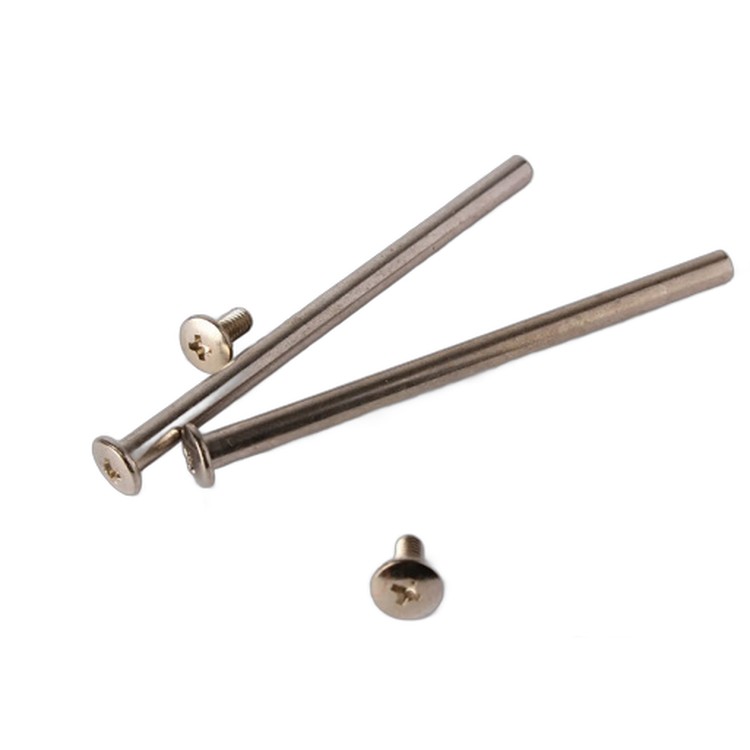
Take the long-pin rivet in the reference photo as an example. Getting from raw material to finished part involves several steps — cold heading the head, forming the shaft — and every one of those steps uses a lubricant or cutting fluid to reduce friction between the tooling and the material, prevent surface galling, and hold dimensional accuracy. That oil isn't a defect; it's a necessary part of the process itself. A part coming off the line with oil on it is normal. What actually determines the outcome is whether that oil gets removed completely afterward.
Why we don't just wipe or tumble-clean it
These long rivets have tight verticality requirements, and we run 100% inspection — every single piece goes through a dedicated fixture to confirm it meets spec. That also means the cleaning step can't be rough. A cleaning method with physical contact — brushing, tumbling — risks damaging the verticality and dimensional accuracy that was just achieved, undoing the machining work that came before it.
That's why we use electromagnetic wave cleaning to remove the oil — a non-contact method that avoids introducing new damage to precision during the cleaning step itself — followed by rinsing and oven drying to remove any remaining cleaning residue and moisture.
There's nothing wrong with this process on paper. But precisely because every step is designed around protecting precision through non-contact methods, it's harder to catch a shortfall by eye or by feel at any single step — which is exactly why the weak link usually doesn't show up until the part has already started to rust.
Where a shortfall in cleaning can lead to rust
1.Incomplete oil removal during electromagnetic wave cleaning If the oil film isn't fully broken down and removed at this step, the leftover residue covers the oxide layer underneath, isolating that area from air instead of letting the oxide layer protect it — and that trapped, oil-covered surface is more prone to holding moisture and starting to corrode in a humid environment.
2.Residual cleaning medium left after rinsing If rinsing after the degreasing step isn't thorough, residue from the cleaning medium itself — particularly anything carrying chloride ions — is one of the most common triggers for breaking down a stainless steel passive layer, leading to localized pitting even from a trace amount of residue.
3.Incomplete drying, or re-exposure to moisture after drying If the oven drying time or temperature isn't sufficient, a rivet can look dry on the surface while moisture is still trapped in hard-to-see spots — small gaps at the head-to-shaft junction, for example — and combined with a humid storage or packaging environment, that's where rust tends to start first, in places that aren't easy to inspect.
4.Geometry that naturally traps residue The junction between the head and the shaft, and features like threads or a cross-recess drive, naturally trap incomplete cleaning residue more than a smooth shaft does. These are usually the first spots to rust, and the easiest to overlook during inspection.
How to trace which step actually failed
Mistakes we see
1.Assuming a stainless part must be counterfeit or off-spec the moment it rusts, when the material is often fine and the cleaning step is the actual cause.
Focusing cleaning verification on the smooth shaft while overlooking the head-shaft junction or thread/recess features, which trap residue more easily.
3.Checking only whether the drying time was long enough, without confirming that moisture actually cleared out of small gaps in a humid environment.
Questions we actually get asked
Q: If it's stainless steel, why would it rust at all? A: Stainless steel's corrosion resistance comes from an extremely thin oxide layer on its surface. If that layer gets covered or damaged by residual oil, cleaning agent, or other contamination, the part can rust locally regardless of whether the material itself is fully compliant.
Q: Why is there oil on the rivet right after machining? A: Using lubricant or cutting fluid during forming and machining is a normal part of the process — it reduces friction and helps hold dimensional accuracy. Having oil on the part when it comes off the line is expected; what matters is whether it's fully removed afterward.
Q: Why not use a simpler cleaning method, like wiping or tumbling? A: These long rivets have tight verticality requirements and go through 100% inspection. Any cleaning method involving physical contact risks damaging the precision that was just achieved, so we use a non-contact electromagnetic wave method instead — trading process simplicity for protecting that precision.
Q: Does rust mean the whole batch is defective? A: Not necessarily. If rust is limited to specific features — like the thread or the head-shaft junction — it's more likely an uneven cleaning coverage issue in that batch, rather than a problem with the material or the entire process. It's worth tracing the specific step using the approach above before drawing a conclusion.
Further reading :
Why Does a CNC Part Fail Tolerance Inspection?
Running into similar rust issues? If you're seeing localized rust on parts you've received, feel free to contact our engineering team — we can help trace whether it originated in cleaning, drying, or storage. Talk to our engineering team
Contact: Jeffrey Chen
Phone: 18896588126
Tel: 0512-63256033
Email: Sales@fusort.com
Add: Fenhu Economic Development Zone, Wujiang District, Suzhou City, Jiangsu Province, China